India Electric Vehicle Aftermarket Size, Share, Trends and Forecast by Replacement Part, Propulsion Type, Vehicle Type, Certification, Distribution Channel, and Region, 2026-2034
India Electric Vehicle Aftermarket Overview:
The India electric vehicle aftermarket size reached USD 3.3 Million in 2025. Looking forward, IMARC Group expects the market to reach USD 16.3 Million by 2034, exhibiting a growth rate (CAGR) of 18.98% 𝕴during 2026-2034. The market is driven by increasing electric vehicle (EV) adoption, strong government incentives, rising demand for battery replacement, growing charging infrastructure, boosting maintenance services, and expanding localized component manufacturing to enhance sustainability and affordability.
|
Report Attribute
|
Key Statistics
|
|---|---|
|
Base Year
|
2025 |
|
Forecast Years
|
2026-2034
|
|
Historical Years
|
2020-2025
|
| Market Size in 2025 | USD 3.3 Million |
| Market Forecast in 2034 | USD 16.3 Million |
| Market Growth Rate 2026-2034 | 18.98% |
India Electric Vehicle Aftermarket Trends:
Growing Demand for Battery Replacement and Recycling
The growing demand for battery replacement and recycling emerges as an essential aftermarket opportunity because of the growing electric vehicle (EV) adoption throughout India. This shifting trend is significantly boosting the India EV aftermarket share. In addition to this, EV batteries based on lithium-ion technology reach the end of their lifespan at five to eight years leading to replacement. Moreover, expanding Indian government initiatives for sustainable battery recycling and secondary use applications drive companies to build battery recycling facilities. For instance, in the 2025 Union Budget, the Indian government eliminated customs duty on importing waste lithium-ion batteries and scraps of 12 critical minerals, including copper and tin. This policy change aims to boost domestic battery recycling industries by reducing raw material costs. Besides this, multiple companies including startups and firms continue to research battery refurbishment solutions that lower the cost of EV battery replacements for owners. Furthermore, the aftermarket sector is transforming due to continuous advancements in battery technology that include solid-state batteries and enhanced lithium-iron-phosphate (LFP) chemistry. Also, the Battery Waste Management Rules 2022 enforce extended producer responsibility (EPR) through which manufacturers need to establish recycling and collection networks. As a result, the market demands businesses specializing in battery diagnostics and refurbishment services along with responsible battery disposal to build sustainable circular systems for India's EV infrastructure, thereby driving the India EV aftermarket growth.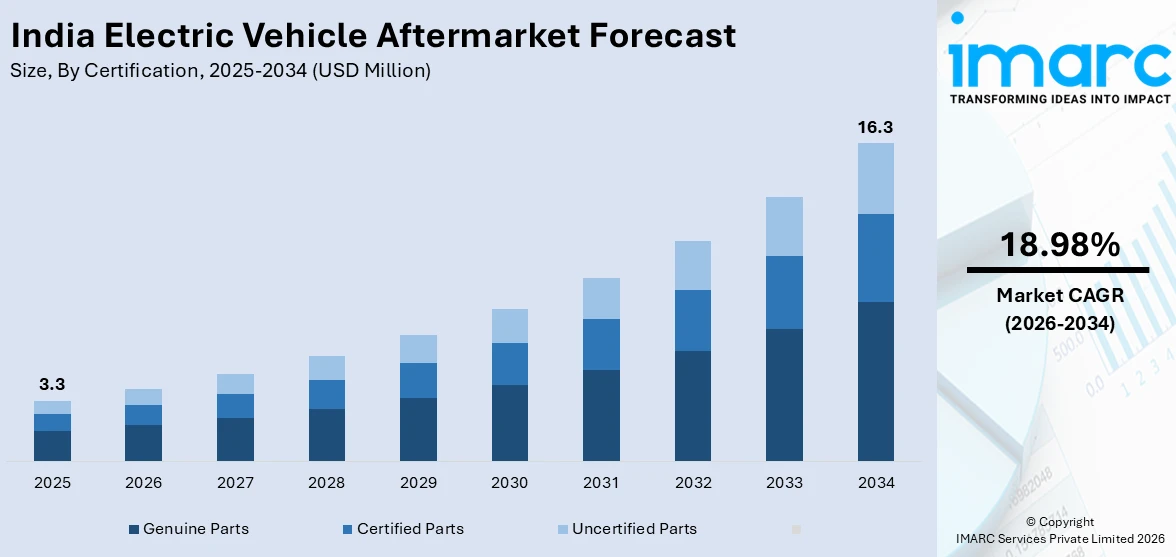
To get more information on this market Request Sample
Expansion of EV Service and Charging Infrastructure
The growing popularity of EVs has triggered substantial investments toward developing service centers and charging networks throughout India. In line with this, traditional service providers now address EV-specific maintenance needs, including battery health management, motor repairs, and vehicle software updates, ensuring optimal performance and longevity. Many companies have established their own EV service centers due to the increasing EV consumer demand in the region. The aftermarket industry also experiences a transformative change as businesses station fast chargers and battery swaps across the nation. For example, in January 2024, Maruti Suzuki announced plans to install fast-charging points in India's top 100 cities and is considering launching a battery rental service to attract EV buyers. This initiative aims to address infrastructure and cost concerns, making EVs more accessible to consumers. Additionally, the FAME II policy and PLI schemes from the government have triggered investments in charging infrastructure through which aftermarket players can create new business opportunities by providing installation, maintenance, and repair services. Furthermore, artificial intelligence (AI)-powered diagnostics with Internet of Things (IoT) technology enhances efficiency by cutting downtime and delivering better customer experiences to automotive markets. As a result, the market entry of additional EV models is driving the ongoing growth of specialized aftermarket services, by sustaining business profitability within this sector and enhancing the India EV aftermarket outlook.India Electric Vehicle Aftermarket Segmentation:
IMARC Group provides an analysis of the key trends in each segment of the market, along with forecasts at the region level for 2026-2034. Our report has categorized the market based on replacement part, propulsion type, vehicle type, certification, and distribution channel.Replacement Part Insights:
- Tire
- Battery
- Brake Parts
- Filters
- Body Parts
- Lighting and Electronic Components
- Wheels
- Turbochargers
- Others
Propulsion Type Insights:
- Battery Electric Vehicles
- Hybrid Electric Vehicles
- Fuel Cell Electric Vehicles
- Plug-in Hybrid Electric Vehicles
Vehicle Type Insights:
- Passenger Cars
- Commercial Cars
Certification Insights:
- Genuine Parts
- Certified Parts
- Uncertified Parts
Distribution Channel Insights:
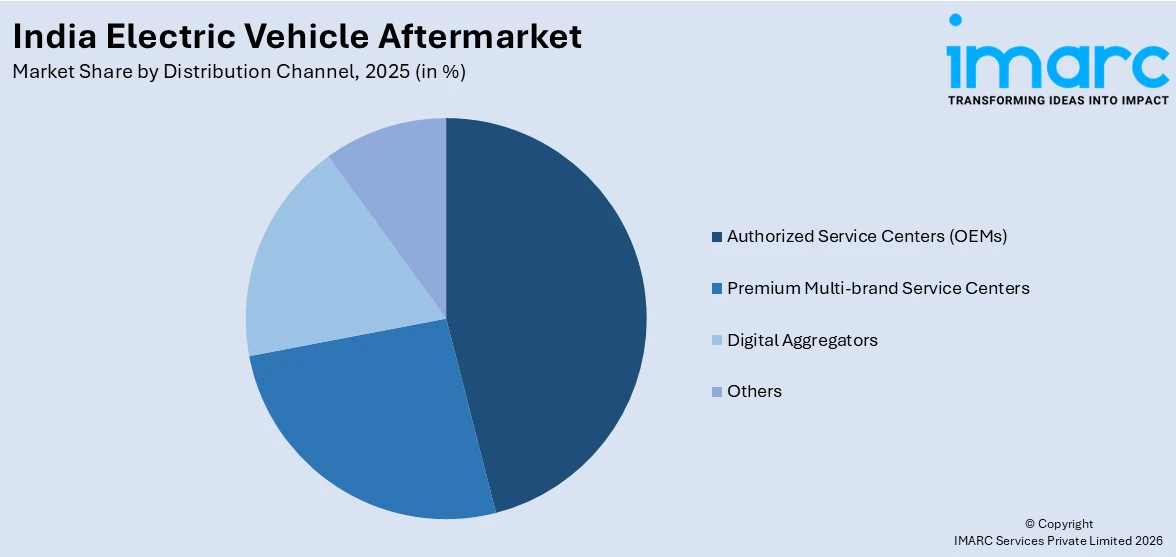
Access the comprehensive market breakdown Request Sample
- Authorized Service Centers (OEMs)
- Premium Multi-brand Service Centers
- Digital Aggregators
- Others
Regional Insights:
- North India
- South India
- East India
- West India
Competitive Landscape:
The market research report has also provided a comprehensive analysis of the competitive landscape. Competitive analysis such as market structure, key player positioning, top winning strategies, competitive dashboard, and company evaluation quadrant has been covered in the report. Also, detailed profiles of all major companies have been provided.India Electric Vehicle Aftermarket News:
- In December 2024, Indian steelmaker JSW announced plans to launch its own EV brand. This move signifies JSW's entry into the EV market, aiming to manufacture and sell vehicles within India, thereby contributing to the diversification and expansion of the EV sector.
- In September 2024, Ola Electric announced plans to add 10,000 partners by 2025 to enhance its sales and servicing network. This initiative aims to address previous criticisms regarding post-sale services and is expected to deepen Ola's reach into urban and rural markets, thereby boosting consumer confidence and adoption rates.
India Electric Vehicle Aftermarket Report Coverage:
| Report Features | Details |
|---|---|
| Base Year of the Analysis | 2025 |
| Historical Period | 2020-2025 |
| Forecast Period | 2026-2034 |
| Units | Million USD |
| Scope of the Report |
Exploration of Historical Trends and Market Outlook, Industry Catalysts and Challenges, Segment-Wise Historical and Future Market Assessment:
|
| Replacement Parts Covered | Tire, Battery, Brake Parts, Filters, Body Parts, Lighting and Electronic Components, Wheels, Turbochargers, Others |
| Propulsion Types Covered | Battery Electric Vehicles, Hybrid Electric Vehicles, Fuel Cell Electric Vehicles, Plug-In Hybrid Electric Vehicles |
| Vehicle Types Covered | Passenger Cars, Commercial Cars |
| Certifications Covered | Genuine Parts, Certified Parts, Uncertified Parts |
| Distribution Channels Covered | Authorized Service Centers (OEMs), Premium Multi-Brand Service Centers, Digital Aggregators, Others |
| Regions Covered | North India, South India, East India, West India |
| Customization Scope | 10% Free Customization |
| Post-Sale Analyst Support | 10-12 Weeks |
| Delivery Format | PDF and Excel through Email (We can also provide the editable version of the report in PPT/Word format on special request) |
Key Questions Answered in This Report:
- How has the India electric vehicle aftermarket performed so far and how will it perform in the coming years?
- What is the breakup of the India electric vehicle aftermarket on the basis of replacement part?
- What is the breakup of the India electric vehicle aftermarket on the basis of propulsion type?
- What is the breakup of the India electric vehicle aftermarket on the basis of vehicle type?
- What is the breakup of the India electric vehicle aftermarket on the basis of certification?
- What is the breakup of the India electric vehicle aftermarket on the basis of distribution channel?
- What is the breakup of the India electric vehicle aftermarket on the basis of region?
- What are the various stages in the value chain of the India electric vehicle aftermarket?
- What are the key driving factors and challenges in the India electric vehicle aftermarket?
- What is the structure of the India electric vehicle aftermarket and who are the key players?
- What is the degree of competition in the India electric vehicle aftermarket?
Key Benefits for Stakeholders:
- IMARC’s industry report offers a comprehensive quantitative analysis of various market segments, historical and current market trends, market forecasts, and dynamics of the India electric vehicle aftermarket from 2020-2034.
- The research report provides the latest information on the market drivers, challenges, and opportunities in the India electric vehicle aftermarket.
- Porter's five forces analysis assist stakeholders in assessing the impact of new entrants, competitive rivalry, supplier power, buyer power, and the threat of substitution. It helps stakeholders to analyze the level of competition within the India electric vehicle aftermarket industry and its attractiveness.
- Competitive landscape allows stakeholders to understand their competitive environment and provides an insight into the current positions of key players in the market.
Need more help?
- Speak to our experienced analysts for insights on the current market scenarios.
- Include additional segments and countries to customize the report as per your requirement.
- Gain an unparalleled competitive advantage in your domain by understanding how to utilize the report and positively impacting your operations and revenue.
- For further assistance, please connect with our analysts.
 Request Customization
 Speak to an Analyst
 Request Brochure
 Inquire Before Buying
Benefits of Customization
- Personalize this research
- Triangulate with your data
- Get data as per your format and definition
- Gain a deeper dive into a specific application, geography, customer, or competitor
- Any level of personalization
Get in Touch With Us
UNITED STATES
Phone: +1-201-971-6302INDIA
Phone: +91-120-433-0800UNITED KINGDOM
Phone: +44-753-714-6104Email: [email protected]
Client Testimonials



.webp)




.webp)