Tyre Pyrolysis Cost Analysis: Turning Tyres into Value

What is Tyre Pyrolysis?
Tyre pyrolysis refers to a thermal recycling process whereby waste tyres are transformed into recyclable materials using a process of pyrolysis. Pyrolysis refers to a process whereby tyres are heated in the absence of oxygen to produce various useful resources. When tyres are subjected to elevated temperatures in the absence of oxygen, the various polymers found in tyres are reduced to simpler components without undergoing the process of combustion. This process usually yields components such as pyrolysis oil, carbon black steel wire, and non-condensable gases. Tyre pyrolysis aims to recover various resources from waste tyres, which are usually hard to recycle since they consist of different materials.
Key Applications Across Industries:
Tyres undergo several processes in pyrolysis, each of which has various industrial uses. Pyrolysis oil is one of the main products obtained in this process. It can be utilized as an alternative product in various industrial furnaces, cement plants, and boilers. On the refined scale, this product can also be utilized as a refinery feedstock. Recovered carbon black (rCB) is another key product that can be utilized as a reinforcing material in the production of rubber products, like tyres, belts, hoses, and miscellaneous molded rubber products. rCB has other possible uses in plastics, paints, inks, and building materials where color is a key factor for its use. The steel wires recovered in the process are also utilized in the steel industry. The gases that are produced and are not condensable often find an additional use in the same plant as a fuel source. This helps to make an efficient use of the required heating inputs. The direct material usage apart, tyre pyrolytic plants can be considered an essential component of waste management by local authorities. In specific geographical areas, tyre pyrolysis oil is considered for road building, mixed fuels, chemicals, etc. At a general level, it is evident that tyre pyrolysis has implications for resource management and waste minimisation within a number of industries.What the Expert Says: Market Overview & Growth Drivers
The global tyre pyrolysis products market reached a value of USD 2.4 Billion in 2025. According to IMARC Group, the market is projected to reach USD 5.0 Billion by 2034, at a projected CAGR of 8.02% during 2026-2034.
The global tyre pyrolysis market is driven by structural challenges associated with the management of waste tyres and by a growing emphasis on circular economy models. Millions of end-of-life tyres are produced each year, and their bulky and non-biodegradable nature develops into a long-term fire hazard and environmental risk. Pyrolysis offers a route to convert this waste into valuable secondary raw materials, making it an attractive alternative to landfilling or uncontrolled dumping. Among the major drivers are regulatory pressures. Governments and environmental agencies tighten rules on waste disposal, emissions, and extended producer responsibility as incentives for industries to move towards advanced recycling technologies. Tyre pyrolysis therefore falls in line with such policy goals for it reduces the volume of waste and provides material recovery that could displace virgin raw materials. Economic factors are also indicative of market growth prospects for tyre materials used for various industries. The increased price volatility associated with fossil fuels and materials can create interest in alternative materials such as pyrolysis oil and recovered carbon black. Industries with cost stability and diversification needs will identify tyre materials as strategic materials for long-term off-take contracts. Corporate sustainability commitments are accelerating these technologies further. Tyre manufacturers, oil refiners, and chemical producers need to reduce their carbon footprint and improve circularity of materials. Pyrolysis allows these industries to demonstrate their contribution to recycling and green supply chains. Over time, technological advancement in process reactor design, emissions, as well as quality, has contributed to a more reliable waste process, hence acceptability. Together with rising investor attention in waste-to-value technologies, it is evident that tyre recycling processes using pyrolysis in an industrial context are improving globally.Case Study on Cost Model of Tyre Pyrolysis Plant:
Objective
One of our clients reached out to us to conduct a feasibility study for setting up a medium scale 中国·银河贵宾汇(GALAXY):tyre pyrolysis plant.
IMARC Approach: Comprehensive Financial Feasibility
We developed a comprehensive financial model for the setup and operation of a proposed tyre pyrolysis plant in India. This plant is designed to manufacture 20,000 MT of waste tyres annually.Pyrolysis Process: The process of tyre pyrolysis was ꦍfound to be a process of controlled thermal degradation, useful in controlling and obtaining products from waste tyres without the process of combustion. Preparation of materials occurs in the following manner: waste tires are collected and inspected. Due to the size of tires, they are either shredded or cut into small parts. Bead wires in tires, composed of steel, are also removed.
The prepared tyre matter is introduced to a closed vessel designated as the pyrolytic reactor. The vessel is gradually heated while eliminating the presence of oxygen. Consequently, temperatures within the vessel range from 400 to 600 degrees Celsius. As a result, the tyre polymers and synthetic materials, together with the oils, decompose into liquid and gaseous hydrocarbons without undergoing any ignition. As the materials decay, they are accompanied by pyrolysis vapor, which is then redirected to a condensation process. The process continues, resulting in the condensation of liquids derived from the pyrolysis oil. In addition, non-condensable gases are separated, and they are normally recycled into the system to serve as a source of fuel. Inside the reactor, a solid residue is left. This is primarily composed of recovered carbon black and inorganic fillers, which are discharged, cooled, and then treated using a grinding and/or pelletizing process. Steel wire present in the substrates is extracted using magnetic separation and then recycled. Finally, the process involves product handling and quality control, in which the composition of the substances like oil, carbon black, and steel will be ascertained for future use. For this, proper control of emissions will be addressed by including gas cleaning and scrubbing systems, and with this process, tyre pyrolysis becomes an environmentally sound option in waste management.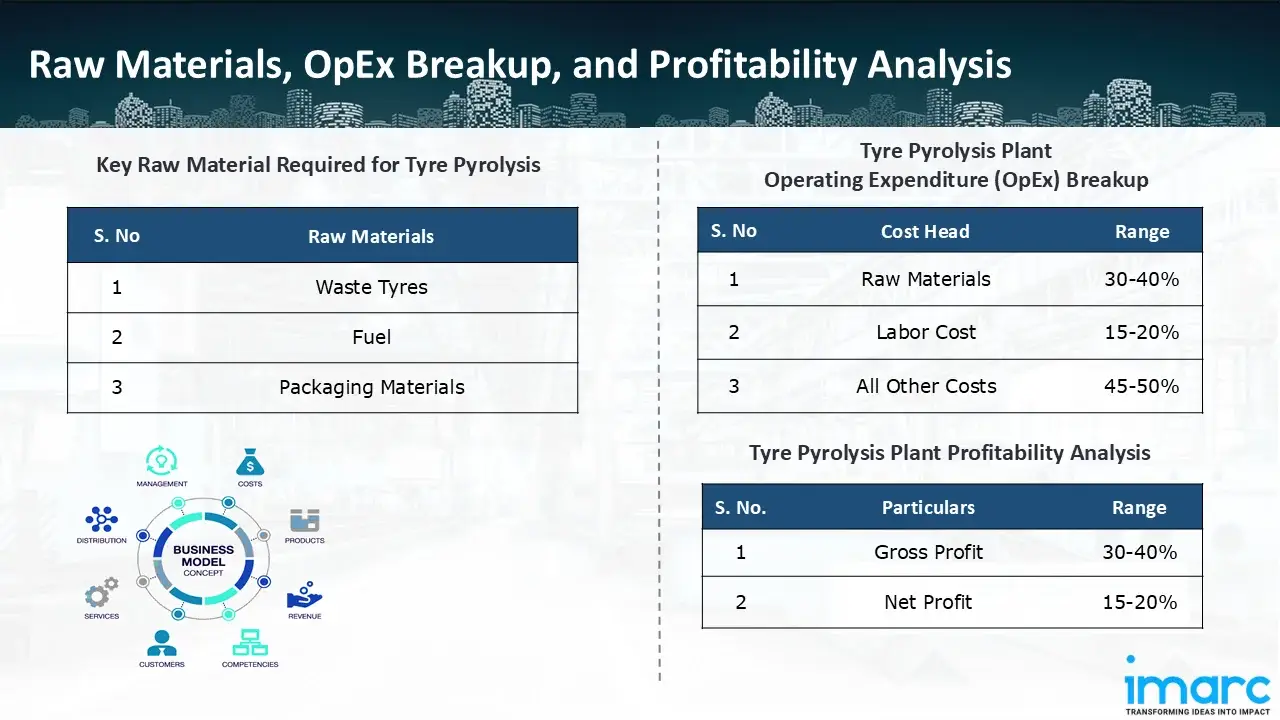
Get a Tailored Feasibility Report for Your Project Request Sample
Raw Material Required:
The basic raw materials required for tyre pyrolysis include:- Waste Tyres
- Fuel
- Packaging Materials
Machine Section or Lines Required:
- Shredding
- Pyrolysis
- Oil Condensation
- Carbon Black Processing
- Packing
Techno-Commercial Parameter:
- Capital Expenditure (CapEx): Capital expenditure (CapEx) in a pyrolysis plant includes various investments essential for its setup and long-term operations. It covers machinery and equipment costs, including procurement, installation, and commissioning. Civil works expenses involve land development, factory construction, and infrastructure setup. Utilities such as power, water supply, and HVAC systems are also significant. Additionally, material handling systems, automation, environmental compliance, and safety measures are key components. Other expenditures include IT infrastructure, security systems, and office essentials, ensuring operational efficiency and business growth.
- Operating Expenditure (OpEx): Operating expenditure is the cost incurred to operate a pyrolysis plant effectively. OpEx in a pyrolysis plant typically includes the cost of raw materials, utilities, depreciation, taxes, packing cost, transportation cost, and repairs and maintenance. The operating expenses are part of the cost structure of a pyrolysis plant and have a significant effect on profitability and efficiency. Effective control of these costs is necessary for maintaining competitiveness and growth. Furthermore, raw material cost in tyre pyrolysis plant ranges between 30-40%, labor cost ranges between 15% to 20%, and all other costs ranges between 45-50% in the proposed plant.
- Profitability Analysis Year on Year Basis: We assisted our client in developing a detailed cost model, which projects steady growth, with revenue rising throughout the projected period. Moreover, gross profit margins lie between a range of 30-40%, and net profit lie between the range of 15-20% during the income projection years, highlighting strong financial viability and profitability.
Conclusion & IMARC's Impact:
Our financial model for the tyre pyrolysis plant was meticulously developed to meet the client’s objectives, providing an in-depth analysis of production costs, including raw materials, pyrolysis, capital expenditure, and operational expenses. By addressing the specific requirements of pyrolysis 20,000 MT of waste tyres annually, we successfully identified key cost drivers and projected profitability, considering market trends, inflation, and potential fluctuations in raw material prices. This comprehensive financial model equipped the client with valuable insights into strategic decision-making, demonstrating our commitment to delivering high-quality, client-focused solutions that ensure the long-term success of large-scale pyrolysis ventures.Latest News and Developments:
- In December 2025, Golden Manufacturers in Wainadoi announced creating the nation's first pyrolysis processing plant, marking a significant advancement in waste management infrastructure in Fiji. The initiative, which will cost about USD 10 million, aims to turn end-of-life tires (ELTs) and plastic trash into fuel products instead of disposing of them in landfills.
- In May 2024, tyre pyrolysis developer Circtec announced raising €150 million to build a factory that would convert used tires into cyclical petrochemical feedstock and renewable drop-in marine fuel in Delfzijl, the Netherlands.
Why Choose IMARC?
IMARC's Financial Model Expertise: Helping Our Clients Explore Industry Economics
IMARC is a global market research company that offers a wide range of services, including market entry and expansion, market entry and opportunity assessment, competitive intelligence and benchmarking, procurement research, pricing and cost research, regulatory approvals and licensing, factory setup, factory auditing, company incorporation, incubation services, recruitment services, and marketing and sales. Under our factory setup services, we assist our clients in exploring the feasibility of their plants by providing comprehensive financial modeling. Additionally, we offer end-to-end consultation for setting up a plant in India or abroad. Our financial modeling includes an analysis of capital expenditure (CapEx) required to establish the pyrolysis facility, covering costs such as land acquisition, building infrastructure, purchasing high-tech production equipment, and installation. Furthermore, the layout and design of the factory significantly influence operational efficiency, energy consumption, and labor productivity, all of which impact long-term operational expenditure (OpEx). So, every parameter is covered in the analysis. At IMARC, we leverage our comprehensive market research expertise to support companies in every aspect of their business journey, from market entry and expansion to operational efficiency and innovation. By integrating our factory setup services with our deep knowledge of industry dynamics, we empower our clients to not only establish pyrolysis facilities but also strategically position themselves in highly competitive markets. Our financial modeling and end-to-end consultation services ensure that clients can explore the feasibility of their plant setups while also gaining insights into competitors' strategies, technological advancements, and regulatory landscapes. This holistic approach enables our clients to make informed decisions, optimize their operations, and align with sustainable practices, ultimately driving long-term success and growth.Our Clients









Contact Us
Have a question or need assistance?
✅ Please complete the form with your inquiry or reach out to us at
ꦇ
+1-201-971-6302
+44-753-714-6104
Previous Post
